The History of Temple Ball Hash
The history of temple ball hash begins over 1,000 years ago in Nepal and India, where sadhus hand-rubbed live cannabis plants to make charas and rolled it into glossy black spheres for spiritual ceremonies inside temples – the original nepalese temple ball. That ancient hand-rolled method traveled the Hippie Trail in the 1960s-70s, nearly disappeared in the 80s-90s, and was revived by the modern solventless movement. Today’s temple ball for sale is the craft evolution: premium temple ball weed washed into Ice Water Hash, then hand-pressed and slow-cured into authentic temple hash balls by brands like Hashtag, Hashish, and Old School Hash Co.
If you have ever searched temple ball hash for sale and wondered why it looks like a shiny black ball and costs more than other hash, this is the story behind it.
TABLE OF CONTENTS
- What Is Temple Ball Hash? Understanding Authentic Temple Balls
- Ancient Origins: The First Nepalese Temple Ball and Indian Charas
- The Himalayan Method: How Traditional Nepalese Temple Ball Hash Was Made
- The Golden Age: Hippie Trail and the Rise of Temple Hash Balls in the West [1960s-1970s]
- The Decline: Why Real Temple Balls Disappeared
- The Modern Revival: How Bubble Hash Became Temple Ball Hash For Sale
- Live Temple Ball: The Next Evolution of Temple Ball Weed
- Traditional vs Modern Craft: Temple Ball Hash Comparison
- Why Temple Ball Hash Still Matters – Why Collectors Hunt Temple Ball For Sale Today
- Where to Buy Authentic Temple Ball Hash For Sale Today
- FAQ About The History of Temple Ball Hash
What Is Temple Ball Hash? Understanding Authentic Temple Balls
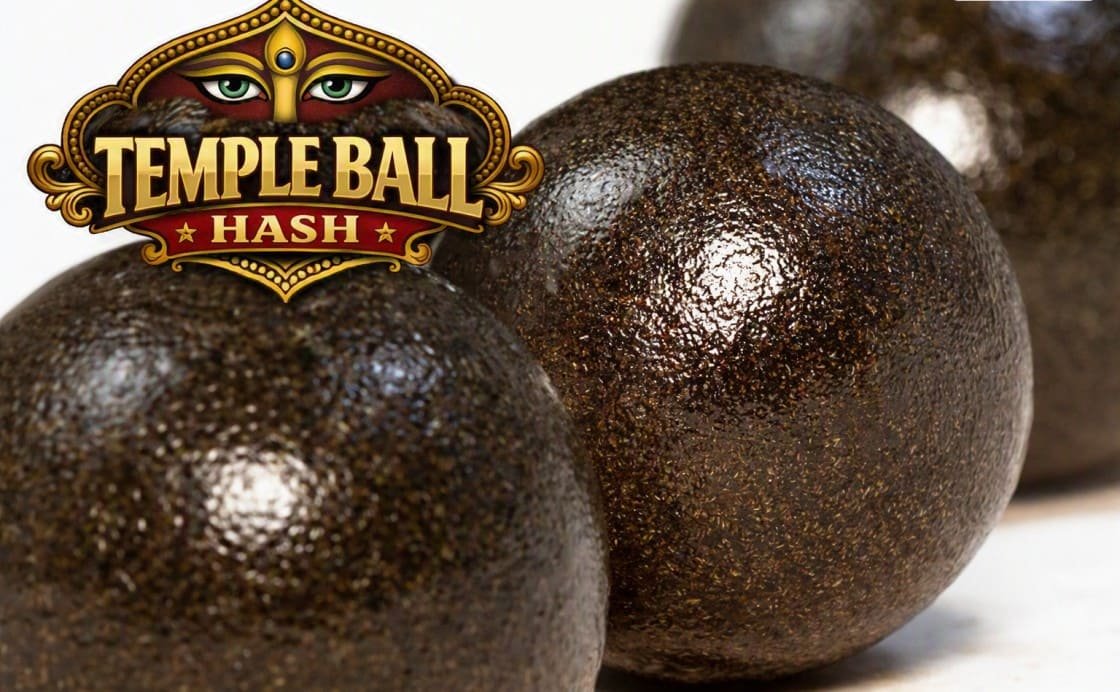
A temple ball is not just hash. It is hand-pressed, slow-cured hashish rolled into a dense sphere. The signature look – dark, shiny, oily exterior with a soft, pliable, terp-soaked interior – is not cosmetic. That oily crust is a natural cure that seals in cannabinoids and terpenes and protects the hash for months.
Modern temple ball hash is defined by three things:
100% Solventless: Made with only ice, water, heat, and pressure. No butane, propane, or solvents ever.
Hand-Rolled: Pressed by hand into perfect temple hash balls, not machine-pressed into pucks.
Slow-Cured: Cured for 14+ days to develop deep, sweet, spicy hash flavor and a full-spectrum high.
That is what separates real temple balls from dry, crumbly hash or distillate. And that method is over a thousand years old.
Ancient Origins: The First Nepalese Temple Ball and Indian Charas in Temples
The history of temple ball hash starts in the Himalayas, long before dispensaries.
India – Charas and Shiva: In ancient India, cannabis was sacred to Lord Shiva. Sadhus and holy men would spend hours hand-rubbing live flowering cannabis plants in the mountains. The sticky resin that collected on their palms was scraped off – this was charas, the earliest form of temple ball weed concentrate. It was used in spiritual ceremonies for meditation and connection.
Nepal – The Birth of the Nepalese Temple Ball: Nepal perfected charas. In the high valleys around Kathmandu and the Annapurna range, farmers cultivated landrace sativas that produced heavy resin. The collected charas was then rolled between the palms with light heat from friction into dense, black, glossy spheres. These spheres were brought to Hindu and Buddhist temples as offerings and for ceremonial use. Pilgrims called them nepalese temple ball hash because you found them in the temples.
This is where the name comes from. A nepalese temple ball was literally hash made for the temples.
By the 1500s, temple balls were a currency along Himalayan trade routes, prized because the ball shape preserved potency far better than loose powder.
The Himalayan Method: How Traditional Nepalese Temple Ball Hash Was Made
Traditional temple ball hash making was pure craftsmanship. No bags, no machines.
The Old Method: Fresh, live cannabis plants were gently rubbed between the hands. The friction warmed the plant and caused trichome heads to stick to the skin. After hours of rubbing, the dark resin was scraped, collected, and then rolled again and again until it became a shiny, oily ball. The heat from the hands partially decarboxylated the hash, making it more potent.
The final temple ball had a hard, almost black exterior. Inside, it was soft, blonde-brown, and incredibly aromatic. That crust was the cure. It prevented oxidation, so a temple ball could be stored for a year and still be soft inside.
This is the exact technique that Old School Hash Co. honors today – old-world soul, but with modern temple ball weed like Green Crack.
The Golden Age: Hippie Trail and the Rise of Temple Hash Balls in the West [1960s-1970s]
For centuries, temple balls stayed in the Himalayas. Then came the Hippie Trail.
In the 1960s and 1970s, thousands of Western travelers backpacked from Europe to Kathmandu. In Nepal, they discovered nepalese temple ball hash in bazaars and temples. It was unlike anything in the West – soft, flavorful, and with a long-lasting, euphoric, clear high that lasted 3-4 hours.
Travelers smuggled temple hash balls back to California, Amsterdam, and London. By the early 70s, temple balls were the most expensive and sought-after hash in the world. Connoisseurs would pay top dollar for a true temple ball for sale because it was full-spectrum and spiritual, not just strong.
This era cemented the legend of temple ball hash as the connoisseur’s hash.
The Decline: Why Real Temple Balls Disappeared in the 1980s-1990s
In the late 1970s, Nepal banned cannabis sales to foreigners under international pressure. The Hippie Trail closed. At the same time, Afghanistan’s hash industry shifted to mass-produced, dry-sifted hash pressed into hard bricks for export.
Real hand-rubbed temple balls became rare. The market was flooded with hard, dry hash pucks that were called temple ball hash but lacked the oily crust, the slow cure, and the soft interior. Many were adulterated.
For almost 20 years, authentic nepalese temple ball style hash was nearly extinct in the West. The knowledge was kept alive only by a few old hash makers in the mountains.
The Modern Revival: How Bubble Hash Became Temple Ball Hash For Sale
The revival started in California and Amsterdam in the early 2000s with two innovations.
Frenchy Cannoli and the Solventless Movement: The legendary hashishin Frenchy Cannoli studied traditional charas making in India and Nepal for decades. He brought the philosophy back: hash is about preserving terroir, not just THC. He taught a new generation that pressing and curing bubble hash using nepalese temple ball techniques creates a superior product.
Ice Water Hash – The Modern Foundation: Instead of hand-rubbing live plants, modern makers wash premium temple ball weed in ice water. Trichome heads freeze and break off and are collected through micron bags. This sandy collection is bubble hash.
Here is the critical link: All authentic temple ball hash for sale today is made FROM bubble hash. The bubble hash is then gently heated, hand-pressed into perfect temple hash balls, and slow-cured for 14+ days – exactly like the ancient method.
This is what brands like Hashtag and Hashish do now. They take exotic temple ball weed like Tropical Cherry, GMO, White Cherry Rose, and Pink GrapeFruit, wash it into ice water hash, and hand-roll it into 1g and 2g temple balls.
The result is the best of both worlds: ancient nepalese temple ball craftsmanship with modern lab-tested potency of 50-72% THC.
Live Temple Ball: The Next Evolution of Temple Ball Weed
The newest chapter in the history of temple ball hash is LIVE.
What Is Live Temple Ball? Traditional temple balls were made from dried flower. Live Temple Balls are made from fresh-frozen temple ball weed – plants frozen immediately after harvest. Washing fresh-frozen flower preserves 40% more live terpenes like Limonene, Caryophyllene, and Myrcene.
HASHISH is the leader in this. Their Live Temple Ball 1g and 2g double-value drops are the modern grail. They have the same dark, shiny, oily crust as a classic nepalese temple ball, but when you break them open, they explode with candy, fruit, and gas terps that old-world hash never had.
A Live temple ball is history perfected. It honors the temple tradition but tastes like modern exotic cannabis.
Traditional vs Modern Craft: Temple Ball Hash Comparison
| Feature | Traditional Nepalese Temple Ball [Ancient] | Modern Craft Temple Ball Hash For Sale [Today] |
|---|---|---|
| Source | Landrace sativa charas hand-rubbed live | Premium temple ball weed – exotic hybrids |
| Method | Hand-rubbed charas, palm-rolled | Ice Water Hash wash + hand-pressed + 14-day cure |
| THC Level | 20% – 40% THC estimated | 50% – 72% THC – Lab-Tested |
| Texture | Hard black crust / soft blonde interior | Dark oily crust / soft terp-soaked live interior |
| Flavor | Earthy, spicy, deep hash | Candy, fruit, gas + classic hash spice – full spectrum |
| Brands | Village artisans | Hashtag, Hashish, Old School Hash Co. |
| Availability | Temples and bazaars only | Curated temple ball for sale online – discreet USA shipping |
Why Temple Ball Hash Still Matters – Why Collectors Hunt Temple Ball For Sale Today
Why do connoisseurs still hunt for temple ball for sale when there are so many extracts?
1. Full-Spectrum Entourage: A real temple ball preserves the whole plant profile – cannabinoids and terpenes – not just THC. Effects last 2-4 hours.
2. Flavor Through Curing: Like aged cheese, the cure deepens flavor. A cured temple ball hash is smoother and richer than loose bubble hash.
3. Preservation: The ball shape is nature’s jar. It keeps temple hash balls soft and loud for months.
4. Culture: Smoking a temple ball is smoking history. From Himalayan temples to modern California labs, you are part of a 1,000-year lineage.
That is why temple balls sell out in days.
Where to Buy Authentic Temple Ball Hash For Sale Today – Hashtag, Hashish, Old School Hash Co.
If you want to experience this history, you need authentic temple balls – not dry pucks.
At Temple Ball Hash, we specialize only in real, hand-rolled temple ball hash for sale:
Hashtag: Small-batch exotic Ice Water Hash temple balls – perfect for flavor chasers. Strains like Animal Mints, Blue Dream, Durban Poison.
Hashish: Masters of Live Temple Ball 1g & 2g double-value – our most potent temple ball hash for sale at 60-72% THC.
Old School Hash Co.: Old-world nepalese temple ball pressing and curing with legendary genetics like Green Crack – true old-school soul.
Every temple ball for sale lists exact THC Levels, Terpenes, and Type: sativa, indica, or hybrid, and is lab-tested and small-batch.
FAQ
ask us
anything
What is the origin of temple ball hash?
Temple ball hash originated over 1,000 years ago in Nepal and India as hand-rubbed charas. It was rolled into glossy spheres for spiritual ceremonies inside temples, hence the name nepalese temple ball.
What does nepalese temple ball mean?
A nepalese temple ball is the original traditional hashish from Nepal – pure charas hand-rubbed from live plants and rolled into a dark, shiny ball used in temples. All modern temple balls honor this method.
what is your opening hours?
*Initial one-to-one consultation, Health & Fitness Assasments Bespoke training program planing, Custom Nutrition plan & recipes. Weekly Progress Reviews
What are temple hash balls made from?
Ancient temple hash balls were made from hand-rubbed charas. Modern temple ball hash for sale is made from Ice Water Hash [bubble hash] that is hand-pressed and slow-cured into a ball.
Are temple balls and bubble hash the same?
No. Bubble hash is the loose, sandy powder collected from ice water washing. A temple ball is what happens after – that bubble hash is hand-pressed and cured into a ball. So every temple ball hash started as bubble hash.
How strong is modern temple ball hash vs traditional?
Traditional nepalese temple ball hash was estimated at 20-40% THC. Modern craft temple ball hash tests at 50-72% THC and 60-80% total cannabinoids due to premium temple ball weed and better washing.
What is temple ball weed?
Temple ball weed is the premium flower strain used to make the hash. For example, Tropical Cherry temple ball weed means the temple ball hash was washed from Tropical Cherry flower, so it tastes like cherry candy.
Where can I buy authentic temple ball for sale today?
You can buy authentic, lab-tested, hand-rolled temple ball for sale at Temple Ball Hash. We carry only real temple balls from Hashtag, Hashish, and Old School Hash Co. with discreet USA shipping where compliant.
Final Thought: From Temples to Your Jar
From hand-rubbed charas in Himalayan temples to fresh-frozen Live Temple Balls in California, the history of temple ball hash is a story of preservation – preserving terpenes, preserving potency, and preserving culture.
When you break open a soft, oily temple ball, you are not just smoking hash. You are experiencing 1,000 years of craft.
Ready to taste history?
